ACORN II
A multi-site randomised controlled trial to evaluate the impact of a group treatment for antenatal anxiety
ACORN II
A multi-site randomised controlled trial to evaluate the impact of a group treatment for antenatal anxiety
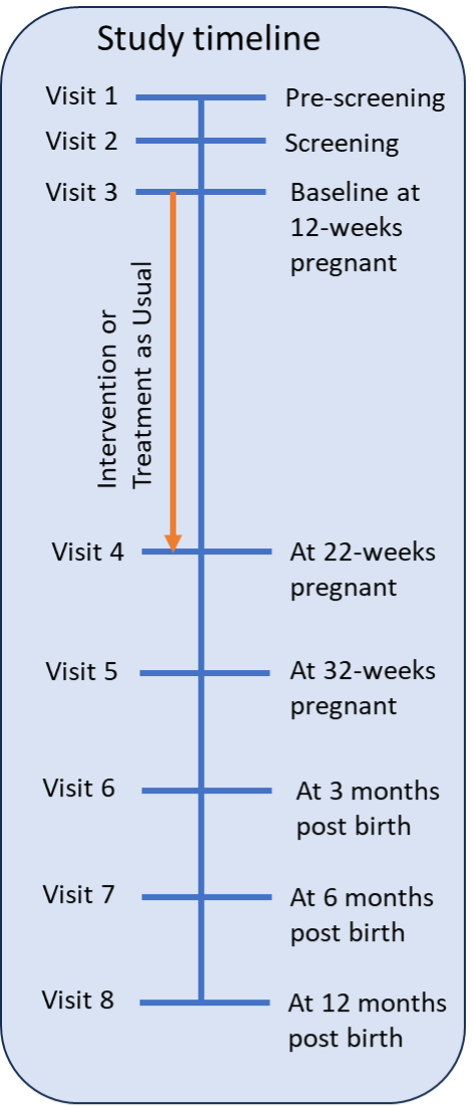
Contact 1 – Pre-screening
Contact 2 – Screening
Contact 3 – Baseline
Contacts 4, 5, 6, 7 – Follow-up visits
Contact 8 – Final visit
The study has been reviewed and approved by the National Research Ethics Service (NRES) Committee (South West – Cornwall & Plymouth Research Ethics Committee). It is sponsored by Devon Partnership Trust and funded by the National Institute of Health Research.
The findings of the study, and anonymised quotes will be published in academic journals, funding reports and presented at research meetings and conferences. However, your name will not be used in any written or verbal reports arising from the research. If you are interested in obtaining a summary of the results, or a copy of any publication(s), please let the study researcher know, and we can arrange to send a copy to you when the summary and/or other publication(s) are available.
Before you consent to the trial we will ask if it is okay for us to share your decision to participate with your GP and midwife. The only information that will be passed onto the GP and midwife would be that screened positive to antenatal anxiety. All data collected during the trial will be kept confidential. The only time we would have to break confidentiality is if there was a safe guarding concern. We would then have to notify the relevant people, which may include your GP or midwife.
People who do not need to know who you are will not be able to see your name or contact details. Your data will have a code number instead.
Once we have finished the study, we will keep some of the data so we can check the results. We will write our reports in a way that no-one can work out that you took part in the study.
You can stop being part of the study at any time, without giving a reason, but we will keep information about you that we already have. We need to manage your records in specific ways for the research to be reliable. This means that we won’t be able to let you see or change the data we hold about you. If you agree to take part in this study, you will have the option to take part in future research using your data saved from this study.
You can find out more about how we use your information
If you have any questions about being in a research study, you can contact the Trust’s Patient Advice Liaison Service (PALS). They will give you advice about who you can talk to for independent advice.
At the end of the study you will receive a thank you voucher for taking part in the study. You will not be paid during the course of the study for any travel expenses if the intervention sessions take place in person.
Who can I contact for further information about taking part?
You can contact the trial manager Antoinette Davey on Antoinette.davey@nhs.net or ACORN-II@exeter.ac.uk
If you wish to complain, or if you have any concerns about any aspect of the way you have been approached or treated during the course of the ACORN-II trial, by University of Exeter, University of Cambridge, University of Birmingham, Manchester University, or by NHS employees, the normal complaints mechanisms will be available to you.
If you have specific concerns or questions about the study, you can contact the study researcher (see contact details below) or the Chief Investigator at the University of Exeter (Professor Heather O’Mahen – telephone: 01392 724651 or e-mail: H.OMahen@exeter.ac.uk).
If you are not happy with the way you have been treated by an NHS service, you have the right to complain, have your complaint investigated, and be given a full and prompt reply. You can ask the organisation (e.g. GP practice, hospital or NHS Trust) for a copy of its complaints procedure, which will explain how to make a complaint. Your first step will normally be to write or speak to the health professional (e.g. the nurse or doctor) concerned, or to the complaints manager within their organisation. Alternatively, you can contact the relevant commissioning body such as the NHS England or a local Clinical Commissioning Group (CCG). You may also wish to seek advice from your local Patient Advice and Liaison Service (PALS) – all hospitals have a PALS Officer. More information about the NHS Complaints Procedure can be found on the NHS Choices website at: http://www.nhs.uk/choiceintheNHS/Rightsandpledges/complaints/Pages/AboutNHScomplaints.aspx
Antenatal
Postnatal
Anxiety
Feasibility study
Randomisation
YOUR RIGHTS
Your usual statutory rights to access, change or move your information are limited, because of exceptions applicable to some types of research, and also because we need to manage your information in specific, lawful ways in order for the research to be reliable and accurate. If you withdraw from the study, we will keep the information about you that we have already obtained. To safeguard your rights, we will use the minimum personally-identifiable information possible.
LEGAL BASIS
As a university we use personally-identifiable information to conduct research to improve health, care and services. As a publicly-funded organisation, we have to ensure that it is in the public interest when we use personally-identifiable information from people who have agreed to take part in research. This means that when you agree to take part in a research study, we will use your data in the ways needed to conduct and analyse the research study.
Health and care research should serve the public interest, which means that we have to demonstrate that our research serves the interests of society as a whole. We do this by following the UK Policy Framework for Health and Social Care Research.
CONTACT US
If you are not satisfied with our response or believe we are processing your personal data in a way that is not lawful you can complain to the Information Commissioner’s Office (ICO). The ICO does recommend that you seek to resolve matters with the data controller (us) first before involving the regulator.
How to contact us
If you have any questions about this study, please contact ACORN-II@exeter.ac.uk


